It’s 2:15 AM on a Saturday, and your phone’s incident alarm is screaming. A wall of automated alerts floods your screen: 502 Bad Gateway. Your production Laravel API is down, customers are locked out, and the clock is ticking on a massive SLA penalty.
What follows is not a clean, single-click fix. It’s an exhausting guessing game in the middle of the night. You open your monitoring dashboard, fire up a terminal, and start digging through systems one by one. You check Nginx, look at PHP-FPM, check Octane, inspect Docker containers, read through log files, and inspect PostgreSQL.
None of these tools show a complete system crash on their own. Instead, the real problem comes from how they interact with each other: a few slow database queries caused PHP requests to pile up, which ran out of available worker processes and left Nginx with nowhere to send incoming traffic.
This cascading reaction is the modern DevOps nightmare. We have the tools to automate infrastructure, but connecting the dots across a broken-up stack late at night still relies on a tired human.
The Big Question: Can AI safely bridge the gap between alert detection, multi-system investigation, and automated resolution, moving us from manual troubleshooting to true autonomous incident response?
What is Model Context Protocol (MCP) for DevOps?
Model Context Protocol (MCP) is an open standard that creates a universal connection between AI models and external software systems in a real-time, context-aware way. Think of MCP as a standardized “plug-and-play” language that lets AI agents in DevOps discover, query, and interact with infrastructure tools without custom code.
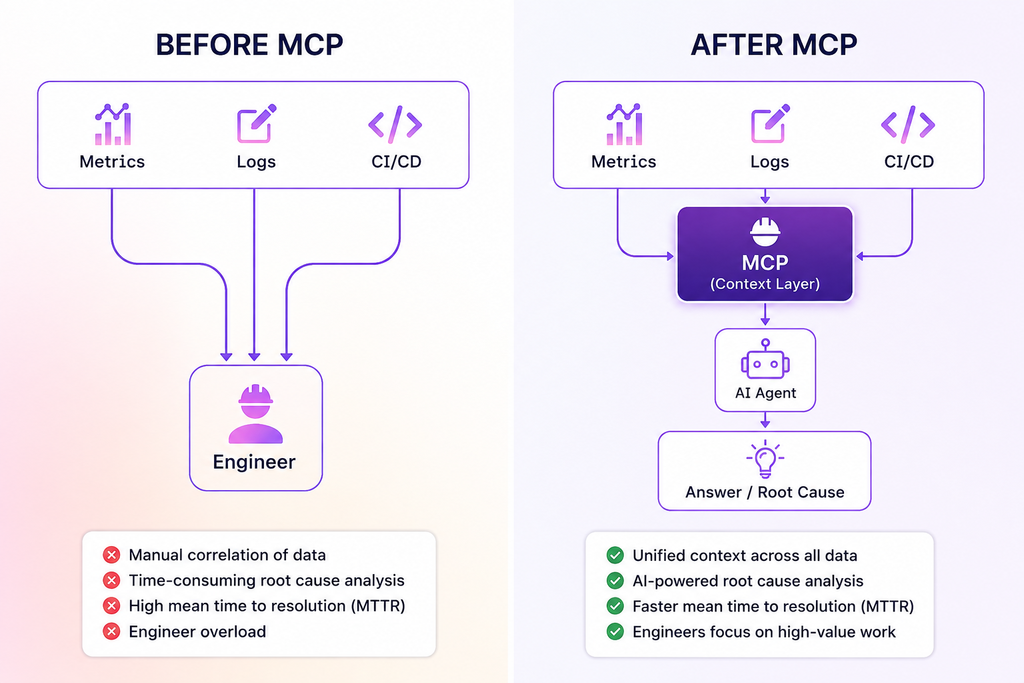
How a DevOps MCP Server Powers AI Agents
An MCP Server exposes executable capabilities known as tools that an AI client can automatically detect and run. Instead of writing hardcoded scripts, an engineer connects a DevOps MCP server, and the AI immediately learns what tools are available, laying the groundwork for AI infrastructure automation.
Without MCP: you paste logs into a chat window and ask an AI what’s wrong. The AI reasons about text. You get generic advice or best-guess analysis based on training data not real AI root cause analysis.
With MCP: AI connects directly to your live Kubernetes cluster, your Grafana instance, your GitHub Actions history, and your Terraform state. When you ask, “why is the payment service latency spiking?” The AI queries all of those systems simultaneously and returns a correlated answer grounded in your actual environment, the foundation of real AI observability and AI-powered DevOps.
What MCP for DevOps Is (And What It Isn’t)
To build a reliable AI-driven operations stack, it helps to understand MCP’s exact role:
- What it IS: An open protocol and standardized API layer that grants AI agents structured access to external environments i.e the connective tissue behind Model Context Protocol DevOps workflows.
- What it IS NOT: MCP is not a standalone AI model, nor is it a replacement for core DevOps tools like Docker, Kubernetes, Terraform, or CI/CD pipelines.
Instead of replacing your existing automation stack, MCP acts as the intelligent interface that lets AI DevOps agents interact with your infrastructure safely and effectively.
Why MCP Changes the Game for Modern Agentic DevOps
Traditional infrastructure automation runs on rigid, predefined logic:
IF cpu_usage > 90% THEN restart_containerThis works for simple failures, but real-world cloud outages are rarely that straightforward. Imagine a scenario where every monitoring system greenlights core health metrics:
- CPU: 65% (Normal)
- Memory: 70% (Normal)
- Services: Nginx, PHP-FPM, and Octane all report running
Despite these green checkmarks, your application is completely unresponsive. Static rules fail here because the system isn’t “down”, it’s suffering from a complex cross-system bottleneck that only an AI SRE agent capable of correlating multiple data sources can properly diagnose.
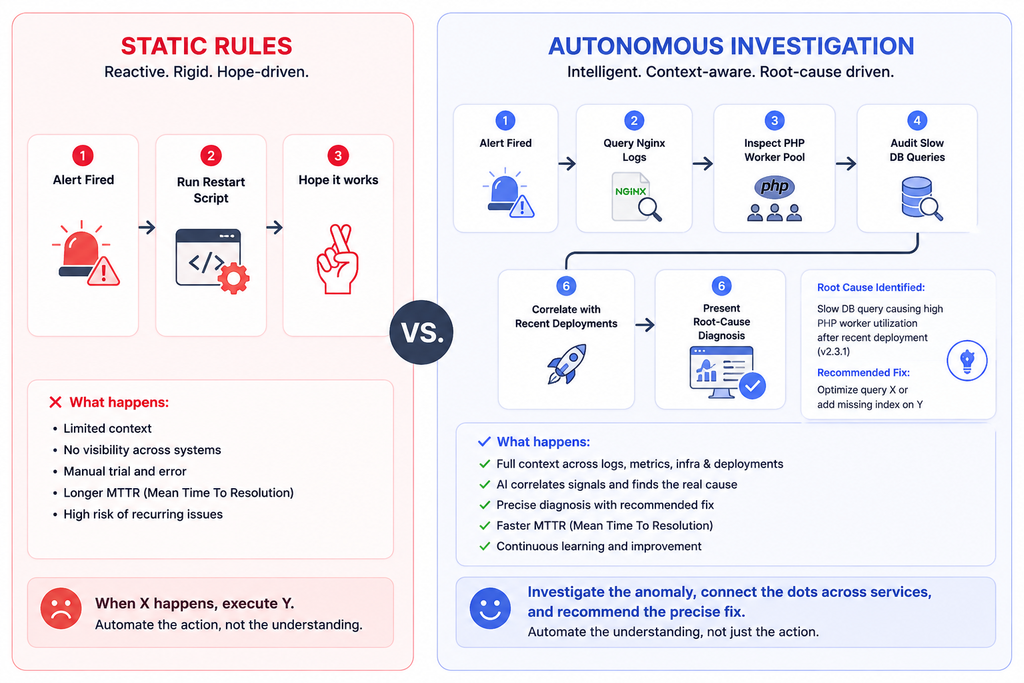
Static Rules vs. Autonomous Investigation
Core DevOps Use Cases for an SRE Agent
Connecting dedicated MCP servers across your cloud infrastructure gives AI agents granular, read-only tools to observe every layer of your stack powering AI infrastructure management and AI cloud automation end to end:
- System & Host Health: server_cpu(), server_memory(), server_load(), server_processes()
- Nginx Reverse Proxy: nginx_status(), nginx_error_logs(), nginx_test_config()
- PHP-FPM & Application: fpm_status(), octane_workers(), laravel_failed_jobs()
- Containers & Orchestration: docker_containers(), docker_container_logs(), docker_inspect()
- Databases: postgres_long_queries(), postgres_locks(), mysql_processlist()
- CI/CD Pipelines: github_latest_run(), github_deployment_logs()
Real-World Example: Resolving a 502 Bad Gateway Outage with AI Incident Response
When a production API breaks, traditional incident response involves manual, sequential terminal checks:
[PostgreSQL] Slow Queries ──► [Laravel] Requests Hang ──► [PHP-FPM] Workers Exhausted ──► [Nginx] 502 TimeoutInstead of running manual diagnostics across five isolated systems, an engineer simply asks the AI: “Why is production returning 502 errors?“
The MCP-enabled AI SRE agent investigates autonomously, performing AI root cause analysis in seconds instead of hours:
- nginx_error_logs() → Flags upstream timeouts.
- fpm_status() → Finds 100/100 workers busy.
- postgres_long_queries() → Detects queries running over 30 seconds.
- github_latest_deployment() → Pinpoints a release pushed 12 minutes prior.
Diagnostic Summary
STATUS: Production API Degraded (502 Bad Gateway)

PROBABLE CAUSE:
Unindexed database queries from Deployment #402 are hanging, exhausting PHP-FPM workers.

SYSTEM STATE:
✔ Nginx / Docker: Healthy
⚠ PHP-FPM: Pool exhausted (100/100 busy)
⚠ PostgreSQL: 4 blocking queries (>30s)
⚠ CI/CD: Release deployed 12m ago

RECOMMENDED ACTION:
Do not restart PHP-FPM. Revert Deployment #402 or terminate hanging DB queries.
The AI collects evidence, maps service dependencies, and presents a root-cause analysis through controlled tools rather than blindly executing shell commands. This turns AI-driven incident response into a repeatable and auditable workflow.
Security & Guardrails: MCP Does Not Mean Giving AI Root Access
Exposing generic execution tools like execute_shell(command) to an AI agent creates unacceptable security risks in production environments.
Safe MCP architecture for autonomous DevOps relies on Least-Privilege Scoping and Human-in-the-Loop (HITL) governance:
- Read-Only Inspection Tools: Standard diagnostic capabilities (nginx_status(), postgres_long_queries()) run freely to investigate incidents.
- Mutating Action Tools: Destructive or service-altering capabilities (fpm_restart(), github_trigger_deployment()) require explicit approval from an engineer before execution.
[ Read-Only Query ] ──► Auto-executed by AI Agent ──► Context Gathered

[ Mutating Action ] ──► Requires Human Approval ──► Service Updated
By enforcing strict tool boundaries and approval gates, MCP transforms AI from an unguided operational risk into a controlled and trusted collaborator. This principle is fundamental to building trustworthy autonomous SRE and cloud operations
MCP Is Not the End of DevOps
It is critical to clarify one major misconception: Model Context Protocol (MCP) does not replace your DevOps stack.
MCP does not replace Docker, Kubernetes, Terraform, Ansible, GitHub Actions, Prometheus, Grafana, or your cloud providers. Instead, MCP sits above these systems as an intelligent, standardized interaction layer for AI-driven cloud operations.
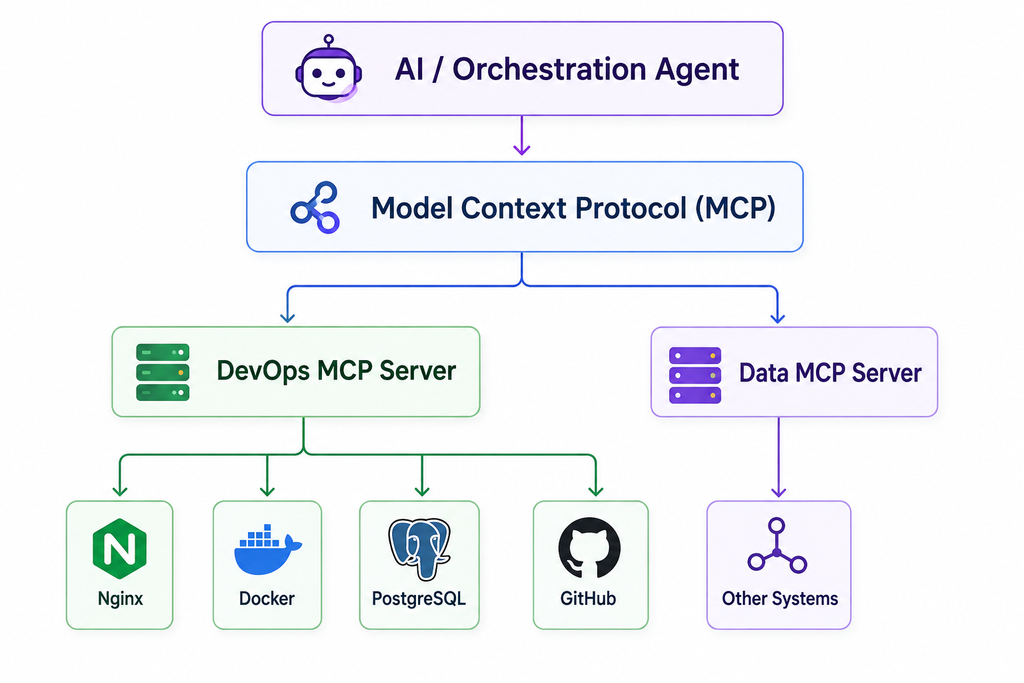
Your cloud infrastructure remains entirely intact. MCP simply provides AI models with a universal protocol to query state, read logs, and trigger safe operational commands across those tools. It reinforces rather than replaces your existing CI/CD pipelines and automated workflows.
What the Future Looks Like: Context-Aware Autonomous Operations
The real breakthrough of MCP isn’t giving AI the ability to run isolated CLI commands. The true paradigm shift is context-aware cloud orchestration powered by AI agents in DevOps.
Imagine giving a single natural-language instruction:
“Deploy the latest release to staging and monitor health for 5 minutes.”
Instead of triggering a basic static script, an MCP-enabled agent manages a multi-system validation loop:
[ Trigger Deployment ] ──► [ Check Containers ] ──► [ Audit App Logs ] ──► [ Evaluate DB Latency ]Scenario A: Healthy Deployment Response
✔ Deployment successful.

Health Verification:
• Nginx: 0 proxy errors
• PHP-FPM / Octane: Worker utilization < 15%
• PostgreSQL: Query latency normal (< 12ms)

Result: No operational anomalies detected.
Scenario B: Anomaly Detection & Rollback Request
⚠ Deployment degraded.

Anomalies Detected:
• Response latency: +48%
• Active PHP-FPM workers: +73%
• Database query latency: +61%

RECOMMENDED ACTION: Rollback to deployment #401.

[ Approve Rollback ]   [ Ignore & Keep Live ]
This represents a true autonomous operations loop: continuous monitoring, multi-system context correlation, automated risk management, and human approval at critical decision points. This is how autonomous incident response and autonomous SRE should work fast, evidence-based, controlled, and accountable.
Conclusion
DevOps has successfully automated the mechanical work of infrastructure. We can spin up clusters in seconds using Terraform and ship code automatically via CI/CD pipelines.
However, operational intelligence has remained a human-bound bottleneck. Understanding why five seemingly healthy services are interacting to cause a 502 outage at 2:15 AM still requires a tired engineer to manually piece together isolated clues.
Model Context Protocol bridges this gap:
- Infrastructure provides the evidence.
- AI investigates and correlates context across tools.
- Engineers retain governance over critical, mutating actions.
MCP isn’t about replacing DevOps engineers with unguided automation. It’s about augmenting them with context-aware, AI-powered agents that can understand infrastructure, respond to incidents, and safely execute operational tasks. This is the foundation of trusted agentic DevOps: autonomous cloud operations and incident response with humans remaining in control.